I have mentioned many times before that I grew up in a “wings, wheels and water” family. My family was a boat, camper, canoe dealer, and more. In fact, my father was the first Skidoo Snowmobile dealer in the state (as well as the only Meyers Manx Dune Buggy dealer). The snowmobile was a great addition to our childhood fun. Maybe it was because I was younger, but it seemed like winters had more snow and lasted longer back then.
The Midwest, where I grew up, is not the greatest place to snow ski. There are a few small hills that a person can ski on. But with the Skidoo snowmobiles, we were snow skiing on water skis behind snowmobiles. When that got boring, we progressed to our version of the snowboard. Thinking back, we probably should have patented the idea and made a bundle on the snowboard craze. But as they say, “hindsight is 20/20.”
Anyway, our house was at the top of a big hill. The hill was big enough that every spring I used it to start my cold-blooded Harley motorcycle. I would push my Harley to the top of the hill, coast down the hill, pop the clutch and hope it would be the first start of the season. If I couldn’t get it started by the bottom of the hill, I had to wait for another warm day and a car to tow the bike back home.
Back to snowboarding. We would take an old wooden water ski and cut off about a foot or two of the length. The older ones were wider and thicker and could withstand the abuse better. After removing the binders, we would install strips of wood across the ski where the binders were located to keep our feet from sliding forward on the ski. We could have left the binders on but boarding barefoot was just too cold and “crazy” for us. At the upturned front of the ski, we drilled a hole. Knotting one end of a short length of ski rope, we threaded it through the hole and tied a loop at the other end for a handle.
At the bottom of the hill there was a flat area that had a few cars parked at the curb. There was a really nice, wooded hill heading down to the street from a local cemetery on the east side of the street. As young snowboarding fools, we used to stand on our modified water skies, grasp the rope like a rodeo star and head down Cemetery Hill towards the street. Ego and youth would have us dodging trees, carving the snow and usually face-planting just before the parked cars. Smart?…no. But at that age, fun!
There we were, snowboarding a couple of times a year and we were expert enough to dodge trees, cars and curbs. We weren’t always in full control. There was the occasional fall that would send the water ski/snowboard sailing between the cars and into the street. There was one occasion that resulted in a few tire tracks on one of the boards. I guess it was just foolish luck, only the board ended up under the passing car. I like using the word “brave” to describe a few of my escapades (although thinking back to those times, “stupid” might be better).
Now, the concern when kids (and adults) do “brave” things is the “liability” that they are creating. Back when I was a kid, I don’t think we had concerns about as many lawsuit or liability threats if the snowboard hit a car. As kids, we didn’t have much money to worry about losing. The snowboard was made from a water ski that no one wanted. If it broke, we just made another one. But now the cost of a good snowboard or a pair of skis can be in hundreds of dollars. The “toys” have gotten more expensive, and the money doesn’t “grow on trees” like when I was young. So now, boards sailing unmanned across a busy street give me chills. Okay, another reason might be because I work in the insurance industry.
What Does This Have to do with Aviation?
As an adult, I figure I shouldn’t personally run into these situations quite as often. I should know better, maybe. But there are many times I thought I knew better but apparently, I didn’t. Like the time I flew a Cessna 150 out of a snow-covered hay field on a ferry permit. Or the time I tried to follow the river home and the ceiling got lower and lower, until I was below the bluffs without floats. Thank goodness for a reliable engine!
It does happen. Right now, you are probably wondering how all this fits into aviation. Well, we make pilot decisions that put us in situations not unlike busy streets and homemade snowboards. And in this case, winter snow brings visions of landing on frozen lakes with (or without) skis.
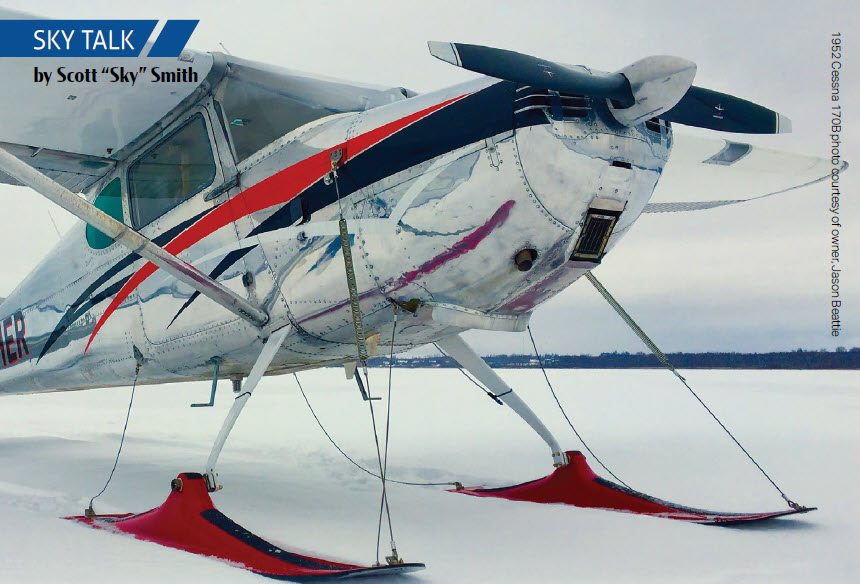
Many a pilot has traded their wheels for skis on the family Cessna 170 or Piper Super Cub to experience the thrill of landing on a frozen, snow-covered lake. Usually, it’s a great experience, but occasionally it has ended with bad results. Like the board and tire tracks, flying on skis can have a disastrous effect on an aircraft if the landing area is not long enough or smooth enough. But if you are interested in experiencing the ski-equipped aircraft world, let’s discuss a few issues.
The first consideration is, what kind of skis are you thinking? When checking with the FAA, they break it into two models; the plain skis and combination skis. With “plain” skis you completely replace the wheels with skis. These would typically be the cheapest option, although they have their own issues. For instance, how do you move the plane around on dry ground?
The “combination” skis combine the wheels with the skis. Either they install around the wheels (letting the wheels stick through for non-snow situations, often called “penetration” skis) or they have retractable wheels. In my opinion, retractable wheel skis mean more money and more weight and are not as practical.
Personally, I would think the best ski option would be the combination skis that let the wheels “penetrate” through the skis. But I think that depends on the type of plane you are using.
On a side note: Years ago we had an ultralight factory in our area. They would put floats on the ultralights and land on snow. I’m not sure they really counts as “skis” but it does appear to work.
There’s another issue when skis replace the wheels. It does eliminate the braking systems. Usually, the friction and drag of the skis, slows the plane down and eliminates the need for brakes. But there is always the risk of ice or too short a runway. There can also be the occasional damage from hidden obstructions, snowdrifts, dirt, or grooves in the ice that catapult the plane to a bone-jarring stop. Ground loops, nose over, and gear damage are usual claims for aircraft with skis attached.
Skis and Insurance
Many insurance companies do not have any language in their policy that excludes converting your pride and joy to skis. A land plane is a land plane. Unlike floats, adding skis doesn’t change that fact. There is an old line in insurance, “If it is not excluded, then it is included.” It is important to look for exclusions but be careful. Policy language can be very confusing. It might not be excluded or included if there is an additional endorsement changing the original language in the policy.
But there are a few companies that just do not like skis. In a quick review, I found a policy that says the following: “The insurance afforded by this policy shall not apply during the operation of the aircraft where the purpose or intent of such operation is any of the following, regardless of whether any change is made: … (g)Taxi, take-off or landing on snow or ice, while the aircraft is equipped with skis.”
Also, you need to make sure the policy doesn’t exclude off-airport landings. If it does, you can’t land at your friend’s farm field or any non-official private airstrip, even if you have access and permission to fly into it (with or without skis). Just to be sure, contact your broker and confirm that off-airport landings and ski use is not prohibited in your policy.
Considerations
There are a lot of things you should consider before adding skis to your aircraft. Below are several things to think about:
- If you purchase insurance, does your insurance exclude skis?
- Can you operate off your home airport with skis?
- How and when will you use them? Only on snow days?
- Can you install them for occasional use?
- What kind of skis, plain or combination?
- Where can you fly with skis?
- Have plain skis? How will you maneuver the plane on dry ground?
Thinking out loud here, if you land a ski-equipped aircraft on a supposedly frozen lake and the plane falls through the ice, what happens? It is now on (or in) the water. Is a seaplane rating needed, along with seaplane insurance coverage? Okay, I’m just joking!