Photos by Jack Fleetwood (www.jackfleetwood.com)
Have you noticed how many Jeep Wranglers there are on the road these days? And not just Jeeps, but four-wheel-drive vehicles in general. For years, people have been buying SUVs with off-road capabilities.
I was reading that the SUV market was about 30 million vehicles worldwide. Just in the U.S., it was estimated that there were over a million units sold in the first quarter of 2021. SUVs seem to be the craze. More and more people want the ability to haul stuff and travel off the beaten path.
Yet the sales go to drivers who are in big cities, sunshine states with no snow or even off-road access. Sure, there are a few owners who are real off-road, bad-weather users, but that’s probably a small minority.
These numbers got me thinking about all the off-road vehicles I have owned. Dune buggies, jeeps, four-wheel-drive pickups, and more. Over the last 40-plus years (guess that makes me sound old) I have had some sort of SUV with four-wheel drive in my garage. I rarely plow my driveway for the snow because I have four-wheel drive. I rarely stay home because of weather because I have four-wheel drive. But I also rarely ever go off-road, unless you call my yard or a gravel road “off-road.” So even though I have owned many an off-road vehicle, my off-road use is very limited.
The same happens for most pilots. How many of you want to own an “off-road” aircraft? I assume you have probably watched the YouTube videos of the STOL aircraft landing on a sandbar in the middle of a river. If you haven’t, you need to.
Or landing uphill on the side of a mountain. Remember in the movie “Air America” when they flew a Pilatus and landed uphill on a little open area on the side of the mountain?
I’ll watch the videos and think “Wow, I want to do that!” But in my reality, it’s not very practical or probable, although I can say I have flown a aircraft into a short farm field covered with snow so that I could pick up a different aircraft to fly out. Kind of my version of a sandbar landing. Or maybe more like a carrier landing, because the plane stopped pretty much the minute it touched down.
It was a great experience, though probably not the smartest thing I ever did. It was a calculated risk, and both the aircraft and I were able to meet the requirements.
Flying ‘Off-Road’
What does it take to fly off-road? Nothing more than an aircraft that is capable and a place to land and take off. Oh, and maybe a bit of piloting skill. Oh, and another thing, practice. The worst thing I can imagine is taking your plane and trying to land off-road, with no idea whether you or the plane can do it. That’s because many off-road airplane owners never go off-road. Like the SUV, they are ready, but seldom, if ever, try it.
But What About Off-Road Aircraft Insurance?
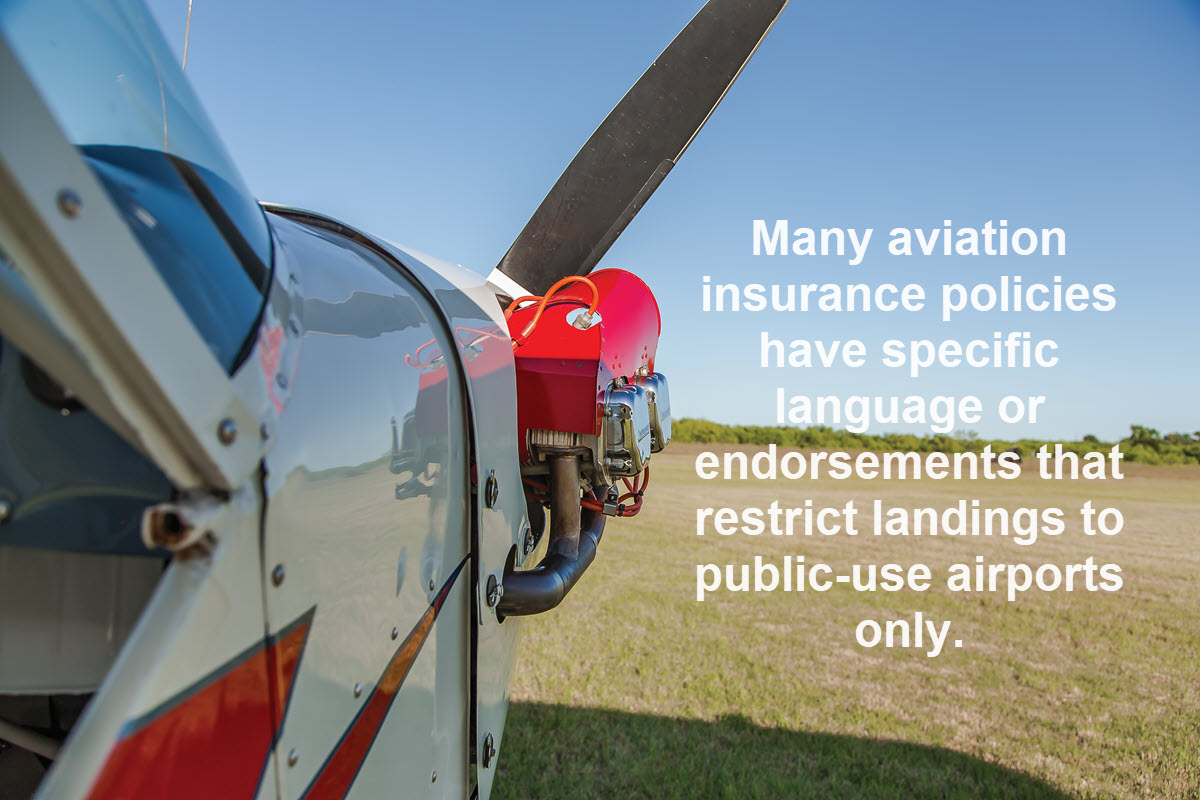
Not every insurance company approves off-airport landings or will pay a claim for an off-airport landing except in an emergency. Many aviation insurance policies have specific language or endorsements that restrict landings to public-use airports only. Why? Because of the increase in risk for the insurance company and the difficulty of recovering the salvage!
Inexperienced pilots taking risks by landing on unimproved airstrips (or fields and roads) increases the risk of the insured having a claim. If the insured does have a claim on a small field or sand bar in a remote location, the insurance company will have difficulty sending in a claim adjuster and recovery crew. So instead of taking on the added risk of a hard-to-reach location, the underwriters sometimes just add a blanket statement that excludes off-airport landings except in the case of an emergency.
On a side note, through the years we have had serious losses in remote areas, and it has taken weeks or longer to find the site of the crash. Accidents do happen, and sometimes recovery is almost, if not entirely, impossible.
How do the underwriters know if you are thinking about landing off-road? The type of aircraft you are insuring. Certain aircraft just seem to be designed for landing on a sand bar, logging road, or in a farmer’s field. You must admit that planes like the Cessna 180 and Piper Super Cub just beg to land off the beaten path. Whether it is on a mountaintop or in the flatlands of the Midwest, some aircraft models just need to experience that off-road landing. And insurance underwriters know that!
As in most things, aviation included, experience is the best teacher. The Danish physicist Niels Bohr said, “An expert is a person who has made all the mistakes that can be made in a very narrow field.” That is tough to do in aviation. If you make all the mistakes, yes, you might be experienced, but only if you are still alive.
Can You Become an Off-Road Expert?
Of course, I think I like a different view, that of Malcom Gladwell in his book “Outliers,” where he mentions the 10,000-Hour Rule. The idea is that to become an expert in any skill, you should practice in the correct way for a total of around 10,000 hours. I have heard that number is disputed, but I think the concept is correct. The more hours you spend practicing, the better you get, and at some point (2,000 hours or 10,000 hours), you become an expert in the area.
When it comes to off-road aviation, practical experience is about the only real way to learn. There is no way a virtual sandbar landing experience is going to be as good as the real thing.
As pilots we want to be experts, but we do not want to make mistakes, as our mistakes can be deadly. And underwriters do not want you to make mistakes and gain experience on their dime. Many insurance companies hope that you will practice and gain experience with someone else (meaning while you were insured by some other underwriting company).
That’s why it’s usually more difficult to get an insurance policy on an off-road aircraft for a low-time, “inexperienced” pilot. But someone will usually take on the risk — for the right price. Usually, but not always. Aircraft, pilot age, and experience will all be a factor with insurance.
Getting Off-Airport Experience
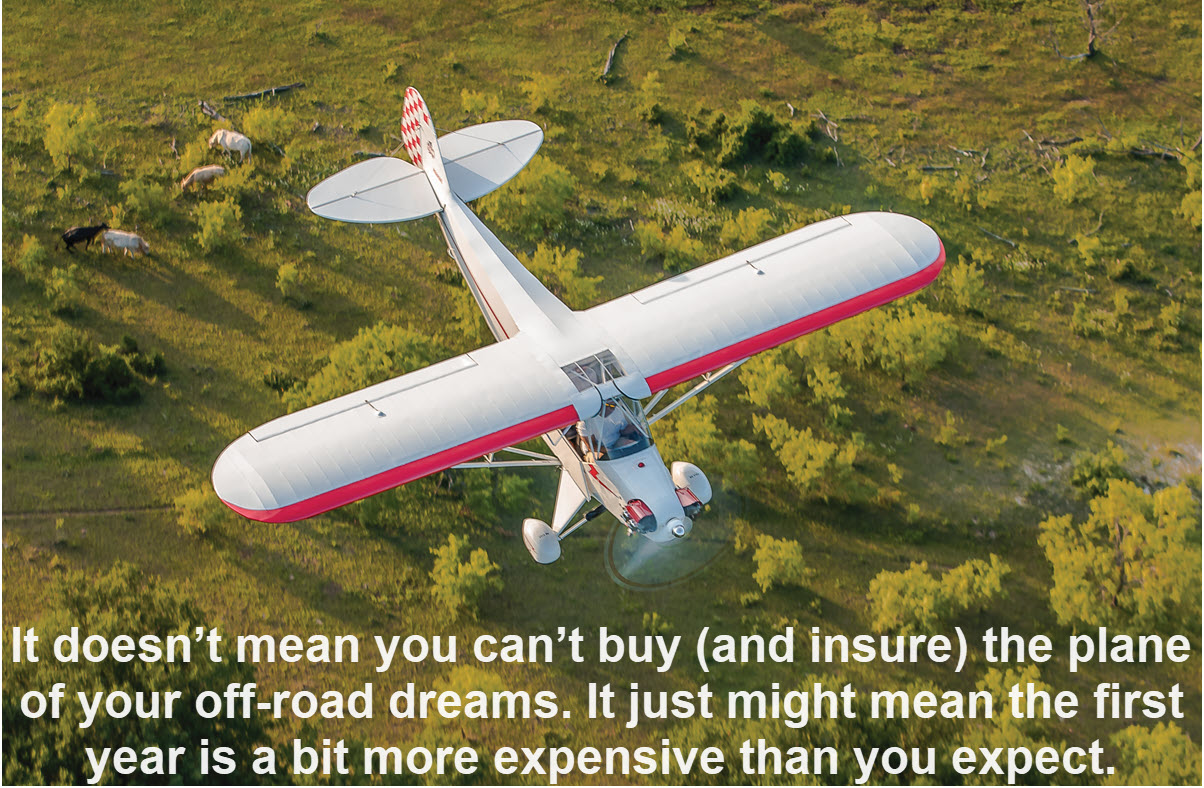
Don’t let insurance detour you from getting the true off-airport experience. It doesn’t mean you can’t buy (and insure) the plane of your off-road dreams. It just might mean the first year is a bit more expensive than you expect.
One idea is to find a friend who has the type of aircraft you want and fly with that friend, searching out unique landing locations to get the experience. Owners’ groups and type clubs are a great resource for connections, and most pilots are pretty good at sharing flying experiences with new friends.
If you want to use your aircraft, have your insurance agent find an insurance underwriter who will let you practice the off-road art form. Then find an experienced off-road pilot (qualified in your aircraft) to help mentor you in this new adventure. Calculate the risk, prepare for the available options, and read the insurance policy.
Getting there is more than half the fun. Don’t waste half the trip!
Getting Practice Time
Disclaimer time — I know I have to write this — I am not with the FAA and I am not a certified flight instructor (CFI). This is just my opinion. That said, my recommendation is to practice before you try the real thing.
So how do you do that?
- Practice on a good, quality flight simulator in the type of aircraft and at the locations you want to try.
- Then practice the full performance envelope of your aircraft during flight. Slow, on the edge of the stall, still in full control, and at all center of gravity (CG) and weight loadings.
- Follow that up with practicing the full performance envelope of your aircraft during takeoff and landing phases. You know, slow speed and short field. Not only on pavement but also grass (wet and dry), rocks, gravel, sand (what about soft or wet sand?), and snow. Personal experience: Be careful of fresh, deep snow over uncut hay. Really shortens the roll out. Just saying.
- Don’t forget to practice approaches and departures over obstacles. What off-road site doesn’t have a tree or boulder in your way? And don’t forget to make these approaches at different useful loads. Flying a 206 or Cherokee 6? Better get experience with a full load. The song goes, “It ain’t heavy” — well, yes it is, and you need to know how to carry the extra load!
- In the beginning, don’t do this by yourself. Hire a qualified CFI to go with you, and don’t get a local CFI who has never landed off-road to give you advice. Nothing against all those CFIs out there, but you need to be trained by instructors who have actually landed in the situations where you want to land.
- If you have never flown out of high-altitude airports, you need to. It is not the best idea to try your first off-road landing at a 1,000-foot strip at 7,500-foot elevation. This is probably a good time to really understand density altitude and your aircraft.
- Plan for your recovery. I’ve had customers who damaged their floats and got stuck on a sand bar. Another hit a boulder they didn’t see on a logging road and took out the landing gear. Once there was a prop strike and no roads to the landing area. The only way to get in or out was by aircraft. The pilot had to get another aircraft to fly out and bring a mechanic and parts back in. In some cases, you can helicopter the plane out, but obviously, that is expensive.
- Always have a communication plan. You can’t get recovered if no one knows where you are. If you might need to wait, have supplies.