Restored ‘Cub Special’ is a Bit J3 and a Bit Super Cub
By Jack Fleetwood
Photos by Jack Fleetwood (https://jackfleetwood.com/).
Last year, when I first flew from Austin, Texas, down to Covey Trails Airport (X09) in Richmond, Texas, I was surprised to find an aviation paradise just outside of Houston’s Class B airspace. As you approach to land on final for Runway 17, you cross over a big shopping center and a busy highway. Somehow, even as this suburban area has surrounded it, this airport has maintained a sense of relaxation and beauty. All around the meticulously maintained turf runway are homes and hangars nestled in the shadows of large trees.
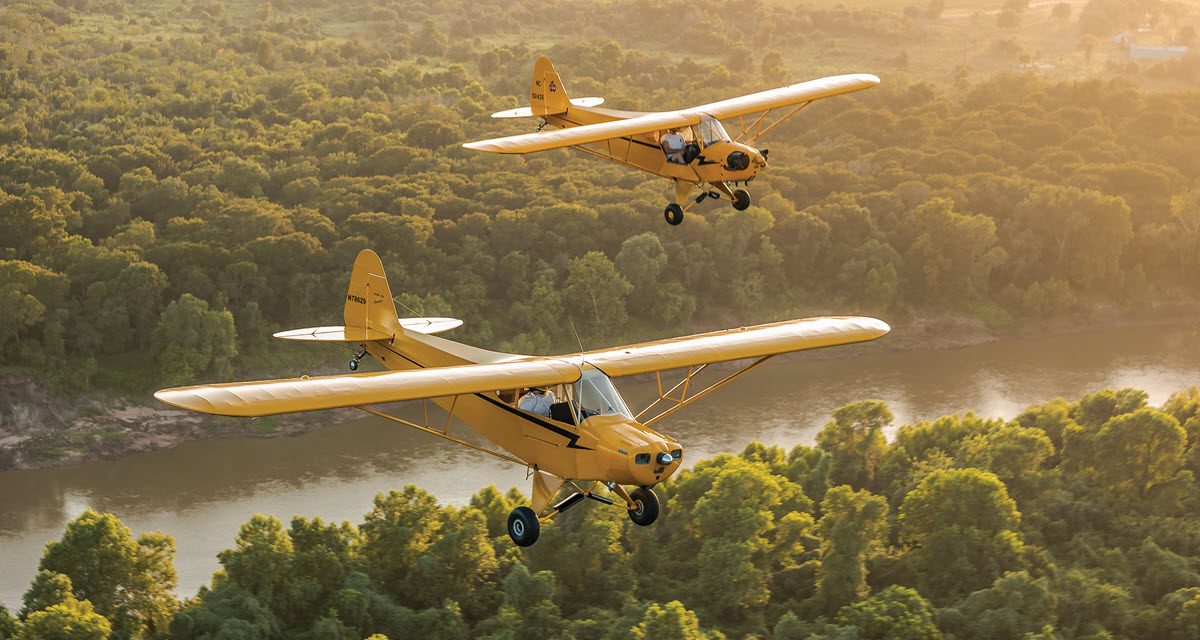
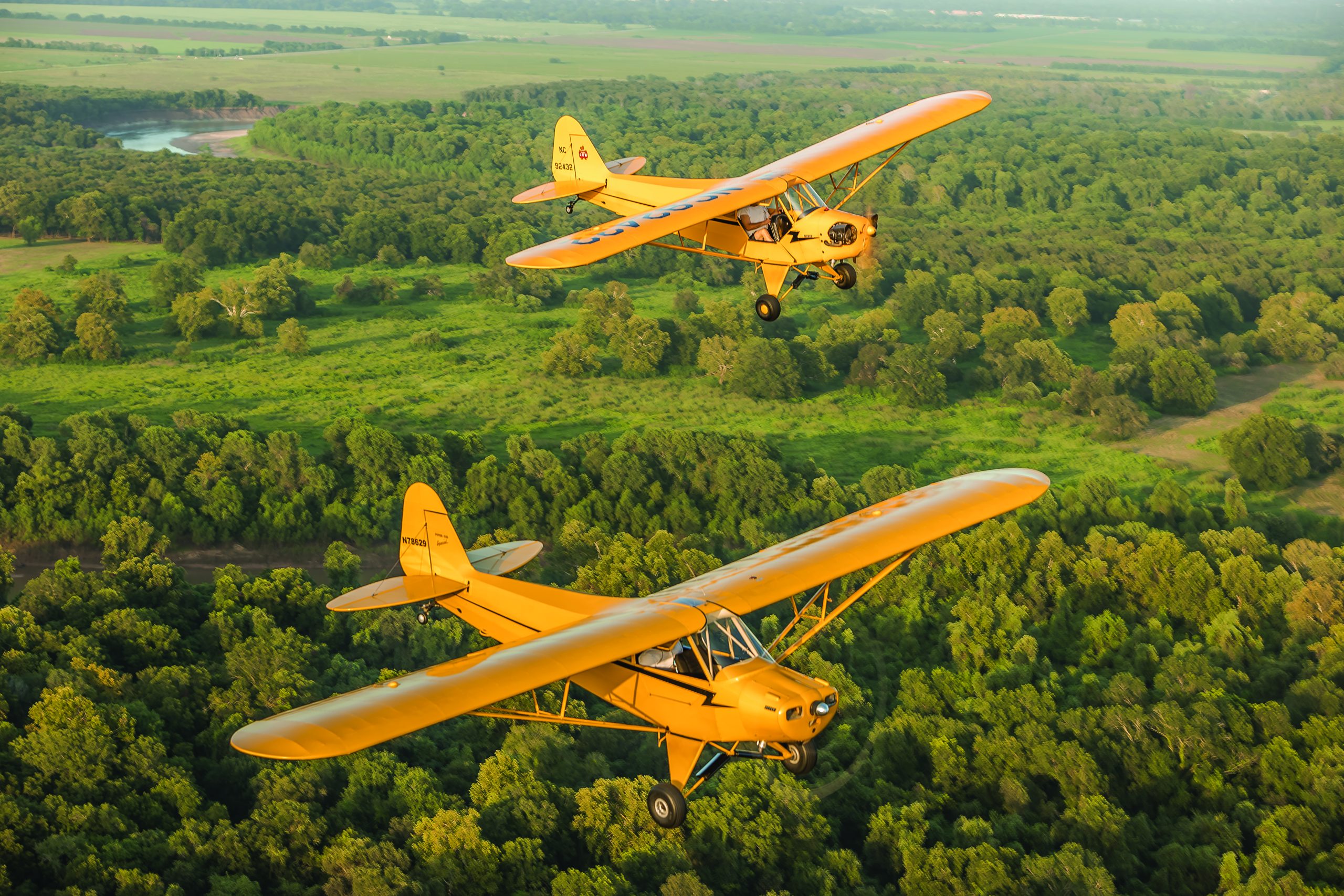
As an aviator, you immediately feel a peace come over you. You just know that a J3 Cub is about to fly over — and it will! Of course, I knew there was at least one J3 on the field. I was there to meet Alan Gillis and take photos of his J3 Cub for PIPERS magazine. Alan introduced me to his friend Jeff Fontenot. Jeff and Alan both live at Covey Trails, and they often fly together, most of the time in formation!
What’s That Now?
Jeff asked me if I knew what a Piper PA-11 was. I had to admit he’d stumped me. Looking back, I should have known what it was. One of my favorite aviation books is “Flight of Passage” by Rinker Buck, where he and his brother restored their family’s PA-11 and then flew it from New Jersey to California when they were only 15 and 17 years old. How could I forget?
Jeff invited me to go see his plane and we jumped on his golf cart and headed to his hangar. My first thought was that it looked like a Super Cub, but no, it’s a Piper Cub Special. As Jeff walked me around his plane telling me about it, including what made it different from a J3 and how it was developed, I immediately knew I wanted to come back and do a photo shoot with him. Over the next year, it seemed storms and busy schedules were conspiring against us. By July, we were all planning a trip to Oshkosh and decided it would be best to get together when we were all back in Texas. Eventually the stars aligned — I jumped in the plane with my photo pilot and we headed that way on a sunny Saturday afternoon.
Closed Cowling
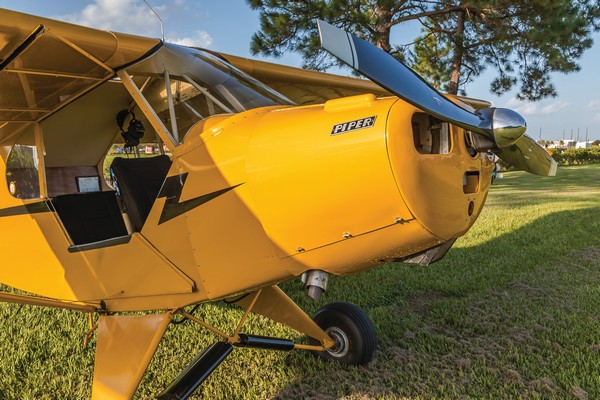
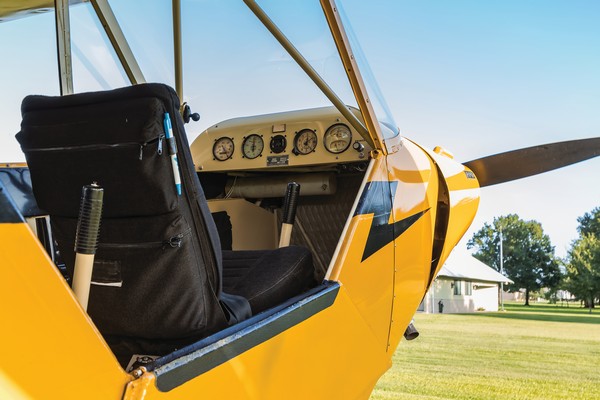
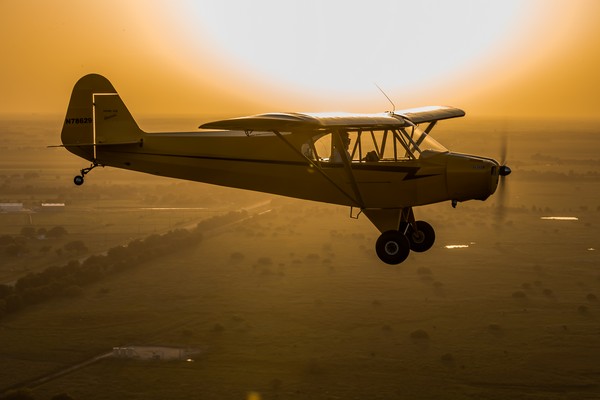
Soon after we landed, two boys came running over from the other side of the airport. I already had my camera out and was walking around Jeff’s PA-11 when one of the boys asked me if I was taking photos of my J3 Cub. This brought back my own childhood memories of running around airports asking questions about airplanes and impressing the old guys with my knowledge! I smiled and told him it wasn’t mine, it was Jeff’s plane, and it wasn’t actually a J3, but very close. I showed him the most distinguishing feature — the closed cowling. He loved it and was ready to learn more, and he headed directly to Jeff!
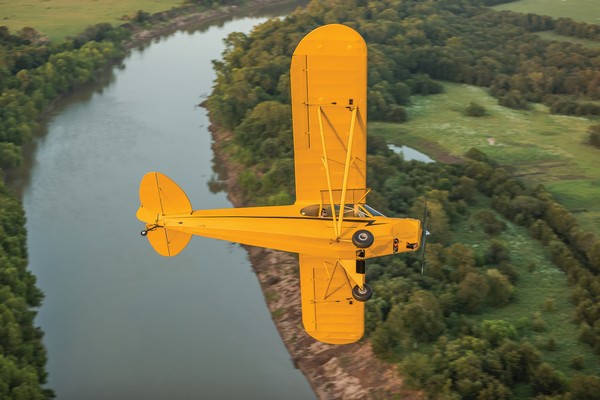
It’s very easy to mistake a PA-11 for a J3; especially Jeff’s plane, since it sports the paint scheme from the J3 instead Eof the PA-11’s schemes — blue over yellow or the later yellow with a single brown stripe. Even if it’s not the designs Piper had in mind, you have to love that famous yellow with the black lightning bolt and the bear cub grinning at you from the tail. The PA-11 looks like it was meant to wear it.
The Evolution of the Cub Special
Unquestionably the most recognizable airplane ever built is the Piper J3 Cub. It was first built in 1937. By the time production ended in 1947, over 19,000 had been produced. Even though it has been almost 75 years since the last one was produced, there are still many clones on the market.
After 10 years, Piper felt it was time to retire the J3 and move on to a newer design. It wasn’t a complete redesign, in fact, the first three produced were made using existing J3 fuselages. They were taking a big risk by redesigning a plane that was already verypopular. The market was changing, though, and the PA-11 was an effort to improve the performance of the Cub to better compete with Champs, Taylorcraft, Luscombe, and Cessna for post-war sales. They needed to improve comfort, serviceability, and speed.
The first Piper PA-11 Cub Special came off the line in the famous Lock Haven, Pennsylvania, factory in 1947. Only 1,541 were sold during the short production run from 1947 to 1949. The first planes were sold with the Continental A65-8 engines, but by 1948 the C90-8 engine was available as an option. Eventually all unsold planes with the A65 would have their engines replaced before being sold.
Some Differences
The PA-11 was one of the first planes Piper used as a test bed for a tricycle configuration. In this configuration, the main gear legs were installed facing the rear of the plane and the nose wheel was attached to the rear engine mounts. As a tricycle-gear airplane, the pilot had to solo from the front seat for balance.
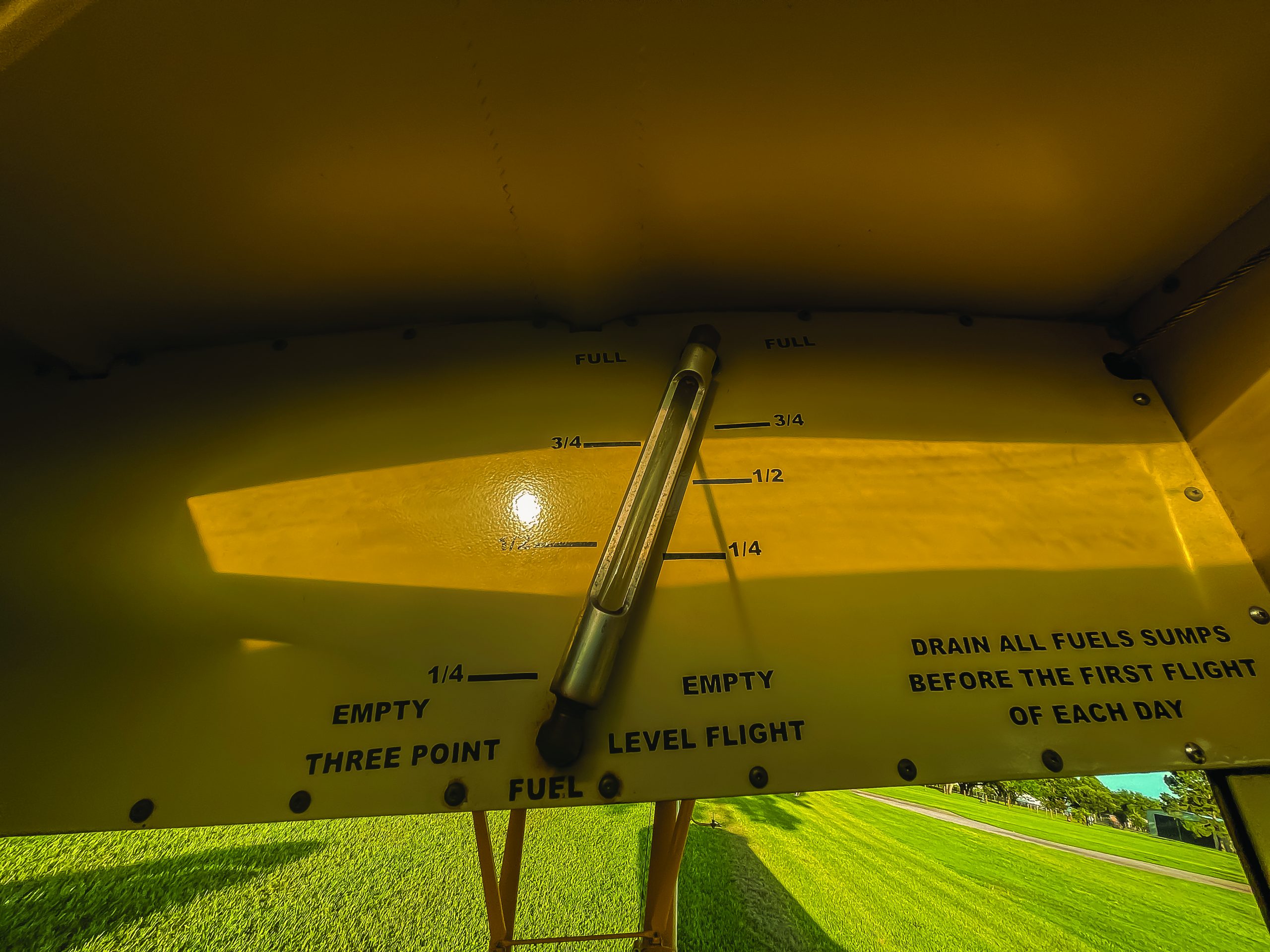
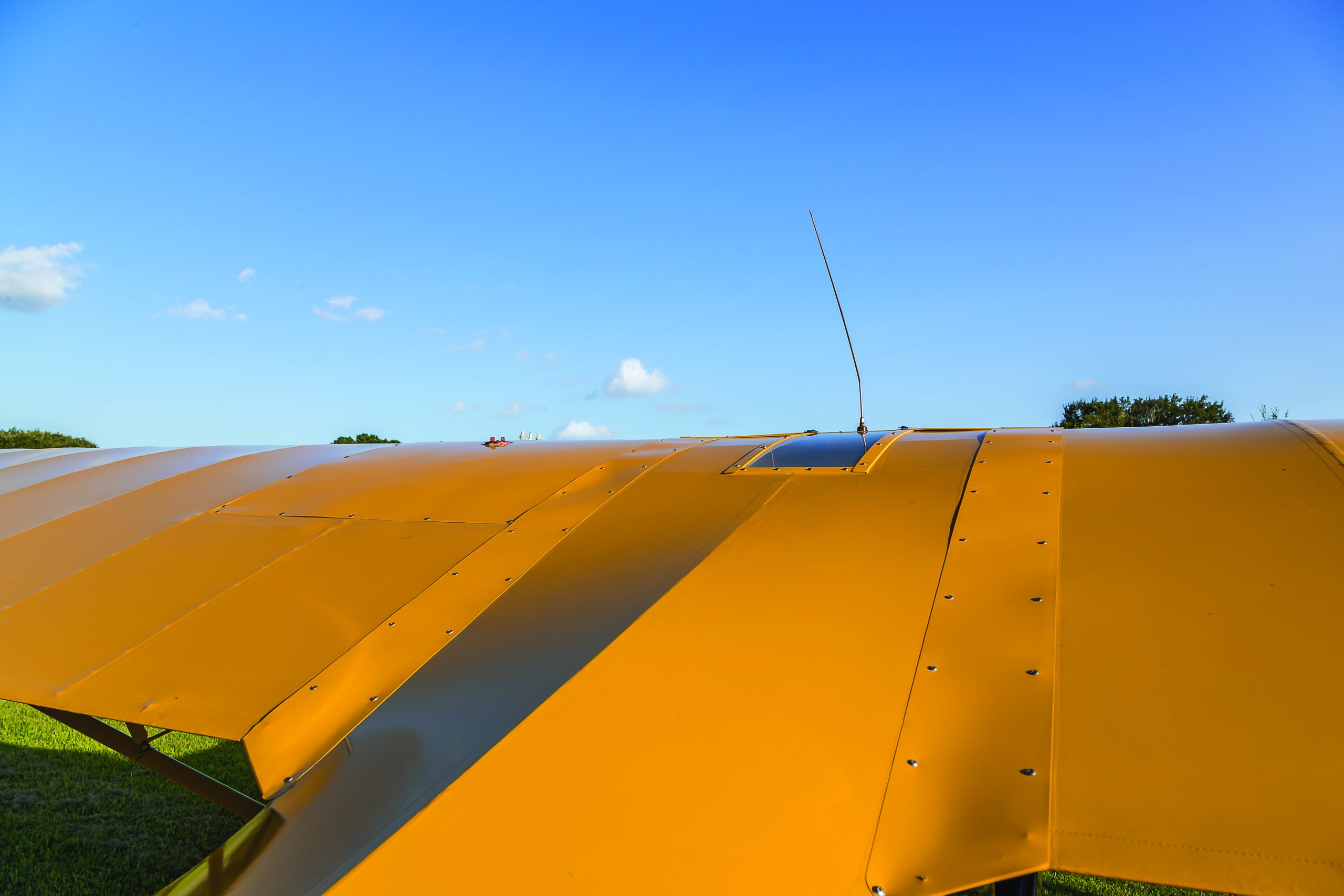
The J3 had a 12-gallon fuel tank in the nose. This was replaced on the PA-11 with a 17-gallon wing tank in the left wing and also with a sight glass in the wing root for a fuel gauge. This got rid of the smell of fuel in the cockpit and allowed the windshield to be sloped more, since the gas cap/fuel gauge is not there. The PA-11 windshield goes right up to the back of the engine cowling.
Moving the fuel tank also changed the CG and allowed solo from the front seat. “I prefer to solo from the rear, though, due to lack of headroom,” Jeff said. He does keep the bottom half of the door closed, since it gets a bit breezy back there!
Front Seat & Instruments
The J3 has tubing in the front seat area running from the bottom corners of the instrument panel to the bottom center of the firewall, between the rudder pedals. These are removed in the PA-11 to give more foot room.
The structural bracing to replace that is an X structure behind the instrument panel, where the fuel tank would be in a J3.
The J3 has a “zero thrust line.” The prop shaft is aligned with the axis of the fuselage. The PA-11 has the engine canted down about 4 degrees. The PA-11 instrument panel is lower height than the J3. The canted engine and lower panel make over the nose visibility much better.
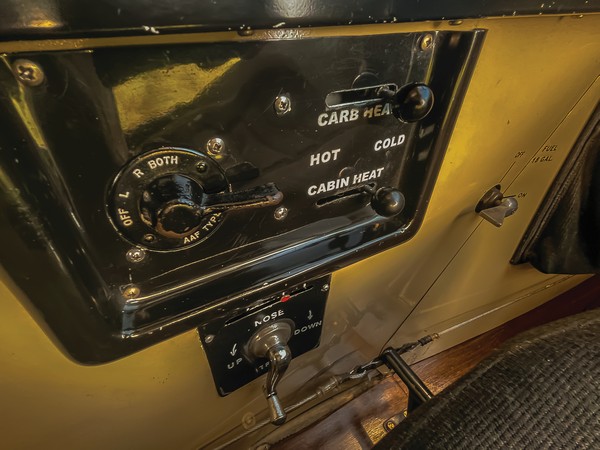
The interior of the PA-11 has sheet metal panels rather than fabric. The removable panels are like the Super Cub interior.
Rear “Seat”
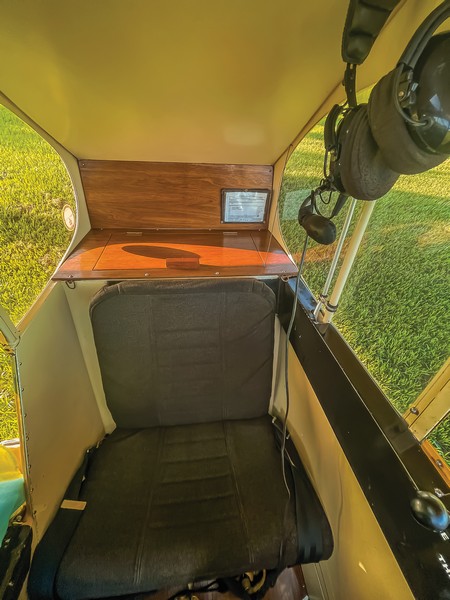
The rear seat of the J3 is a canvas sling that has a horizontal curved arch at the shoulders. The PA-11 has a squared-off rear seat using a metal pan for the seat bottom and plywood for the seat back. The original PA-11 front seat has an arched tubing frame for the base and a seat back that would fold down forward to make rear seat entry easier.
Jeff’s PA-11 has an STC’d Super Cub front seat installed. It sits a little higher and is adjustable.
More Speed Gains
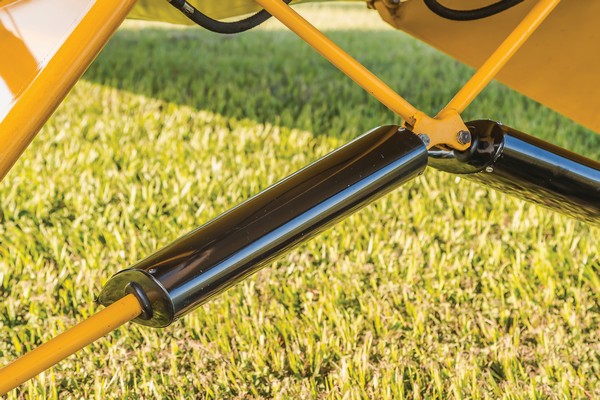
The emphasis on improving speed required reducing drag. The obvious changes are the closed-cowl engine and sloped windshield. Less obvious is that the struts are an airfoil-shape tubing thinner than the J3 struts. The Bungee struts on the landing gear have shorter vertical ears to capture the bungee cords, which allows for a thinner airfoil-shaped bungee cover.
“My plane had J3 bungee struts with canvas-bag-style bungee covers on it when I bought it,” Jeff said. “When I rebuilt it, I put new PA-11 bungee struts with the bag-style covers. Clyde Smith Jr., known as ‘The Cub Doctor,’ told me I could gain 5 mph by installing the streamlined covers.”
It worked, and he confirms it is now 5 mph faster. The PA-11 also has spring assist on the elevator trim. As you trim the nose up, the spring assist pulls the elevator up (probably to counter the thrust due to engine being canted down). All of that carried over to the Super Cub.
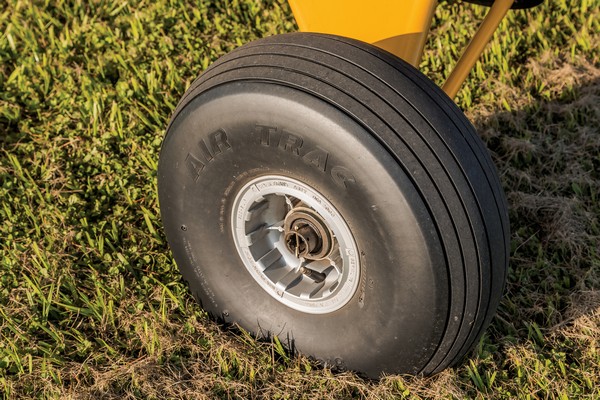
Jeff’s PA-11 had the original J3 style 4-inch wheels, but he replaced them with 6-inch George Adams DGA 2000 wheels and Bodel disk brakes, both through an STC.
A Complete Restoration
“My plane was built in July 1947 at the Ponca City, Oklahoma, plant with a Continental A65,” Jeff said. “It was purchased by a flight school in Bryan, Texas, where it served as a trainer for a few years, then was converted to a crop duster with a C85 engine. In the mid-’50s it was converted back to standard category and sold to a flight school around Fort Worth. In the late ’50s, it went to private owners who moved around Texas, Louisiana, and Mississippi.”
Ultimately, Jeff said, he “bought it from a man that had a ranch in Uvalde, Texas. He had other businesses in Houston and brought the airplane to Houston to have it annualed. He never brought it back to the ranch and sold it to me.”
Jeff then orchestrated a four-year restoration on the plane, which finished in 2005.
“I flew it to Oshkosh in 2011, and in 2012 I flew four hours to the Sentimental Journey Fly-In in Lock Haven, Pennsylvania, for the 75th anniversary of the Cub,” he said. “I enjoy flying it to area fly-ins, giving Young Eagles flights, introducing passengers to ‘low and slow’ flying, but most of my flights are sunset flights spotting wildlife along the Brazos River.”