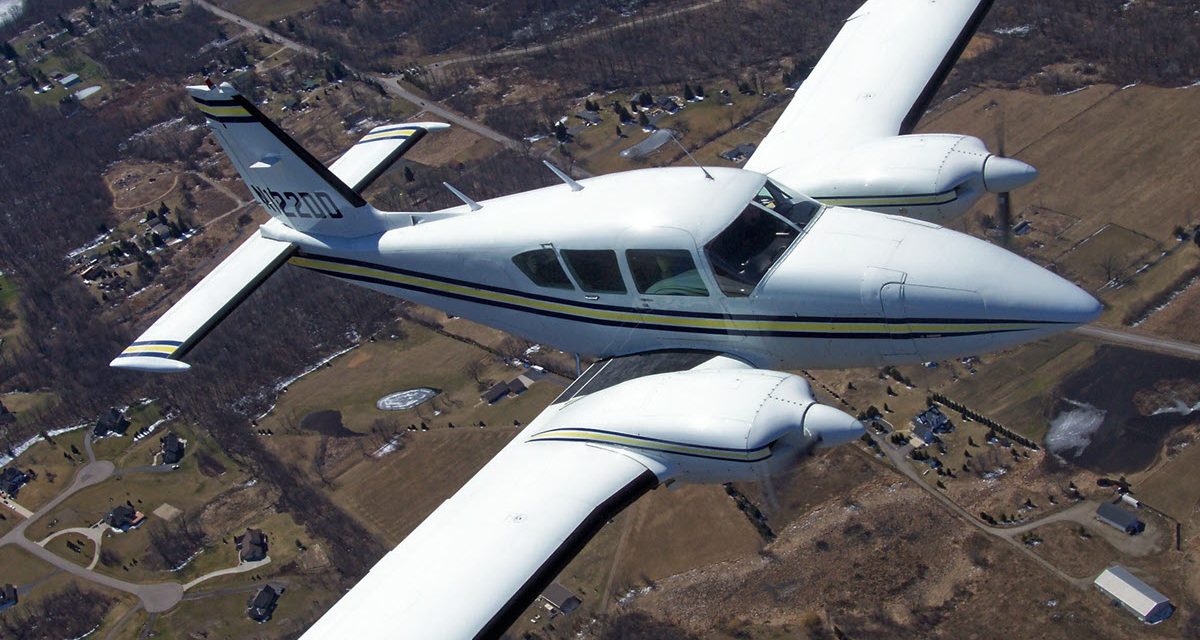
Aztec photo courtesy of Guy Gismondi.
Why own a twin-engine aircraft? Everyone says “for safety.”
Many pilots feel that a multi- (or twin-) engine aircraft is safer than a single-engine aircraft. As you move up the pilot ladder, the logical step up from a single is to a twin. It doesn’t seem to matter if you can afford it, or if you can fly it. It has become the dream for many a pilot.
Just think about it. How many pilots hanging out at the local airport have stated that their next aircraft will be a twin? We’ve all heard it many times before: “If I only had a twin, I’d be traveling more. I’d be going on trips any time I wanted. Rain or shine, I could be flying.”
It seems that the twin implies all-weather ability. It gives pilots, especially non-twin pilots, an impression that the twin is the best way to travel. But is it?
Probably, if the owner uses it as it was designed and gets the right training. And that training can’t stop. Multi ratings ought to have a clause on the license that says something about regular proficiency flights, for instance — training to stay qualified or you lose the multi-engine rating. And that means more than just a BFR or Instrument Competency Check (ICC). That means single-engine work.
Practice Makes Perfect
I know pilots who will disagree, but from my experience in the aviation insurance business, the key to flying a twin safely and proficiently is to get out there and practice. I have personally lost family and friends to twin-engine aircraft accidents. They were great pilots and they had lots of hours. But most of their time was spent traveling in a twin-engine aircraft, not training.
In my opinion, flying by itself doesn’t seem to help as much as actually practicing. And practicing includes single-engine work. It’s apparent in the claims and accident reports that the problem with twins often comes when one engine quits and the pilot thinks they can go on. And usually, the plane can.
The weak link is the pilot who hasn’t practiced and gets behind the airplane. When the ice is building, the turbulence is rocking and rolling (and the baby in the back seat starts to cry), that’s when that automatic, single-engine reflex action really comes in handy.
Single-Engine Practice in a Twin
Isn’t single engine work hard on those engines? Probably. But practice makes perfect. And wouldn’t a little single-engine work (and wear and tear on the engines) be worth that one safe flight?
Want an insurance tip? Don’t be surprised if the underwriter requires school or a flight “check ride” with an instructor in your twin every year! The numbers at the insurance companies show practice and training make a better pilot. And if the numbers show it’s better, they’ll probably require it.
Redundancy vs. Cost
As a pilot, you hate to have anything fail. So, the more things you can have two of, the better off you are. Backup electric, backup vacuum, extra radios, handheld GPS, and backup engine. The extra engine is there not just for carrying more, going faster, or looking neat — it’s there to help keep the aircraft in the air if one engine fails to do its job. Twins offer the extras that most pilots look for if they do a lot of flying — especially if they do a tremendous amount of flying over water, over mountains, or at night. Additionally, twins are good for the pilot that flies over a heavily populated area or in lots of IFR conditions.
But there are other factors besides redundancy to consider before owning a multi-engine aircraft. The biggest problem is the high cost of ownership — not just double the cost (twice the engines) but probably three to four times the operating cost. Why? With two engines you have more cowlings, props, and cables. Not to mention all the associated engine parts and maintenance components. Start adding all these items up. A twin also requires higher labor costs at the time of annuals or even repairs. And ADs? If there is an engine AD, it must be completed on both engines!
The Numbers Bear Out
Statistics show that twin accidents actually have a higher fatality rate than singles. That could be because they are more often flown in rotten conditions. It could also be because they usually haul more people. And it might be because many twins can be purchased at a very cheap price. Perhaps it’s because the pilots that buy them can’t always afford to keep them in tiptop shape or they can’t or won’t stay proficient.
Another factor in the statistics might be that with a single-engine aircraft’s engine failure, you must make a decision right then and there as to where you are going to land. With a twin, most pilots think they can stretch that decision out. They stretch their fuel, they stretch their abilities, and they stretch their nerves. And when all those things get stretched so far, one might fail, and the worst can happen. And sometimes it does.
The Benefits
“But boy, I think owning a twin-engine aircraft would be great.”
Yes, you can buy some twins for much less than a single. In fact, look at the classifieds. Many of the small, medium, and large singles are bringing higher prices than light twins (and even some of the heavier twins). But you have to be careful and not let the purchase price be the only deciding factor.
Experience has shown me that usually the cheaper the aircraft, the more work it will need — you get what you pay for! I bought an old twin once for $6,500, and it flew in! But by the time we
got done pricing the repairs, we decided it would be better if the aircraft went to a salvage yard. Before that could happen, a local broker bought the aircraft. This fine old decrepit twin went to a customer via a local mechanic. At $24,000, the mechanic asked for more money or he wouldn’t continue to work on the aircraft. That didn’t work, and after two years the mechanic resold the aircraft for the unpaid parts bill of $24,000. The new owner ended up putting about $80,000 into the aircraft. It became a great aircraft. But it was no longer a cheap aircraft.
The last buyer knew what he wanted and paid a fair price for a flyable aircraft. The jump in value came from avionics, paint, interior, and engines. The new owner was prepared for that additional cost. The second owner was just buying a cheap twin aircraft that a broker sold him, you know, one of those good time builders.
Keeping It Affordable
The average pilot trying to keep their flying in an affordable category should probably steer clear of the “cheap” twin. Of course, affordable is the key word here. What’s affordable to me might not be affordable to you. The rule of thumb I’ve always used is the fuel burn times four.
Let’s say the aircraft burns 20 gallons per hour (although not many twins have that fuel burn), and the cost of the fuel is $5 per gallon. That’s an hourly fuel burn of $100. In a light twin, the operating costs would run about four times that $100, or $400 per hour.
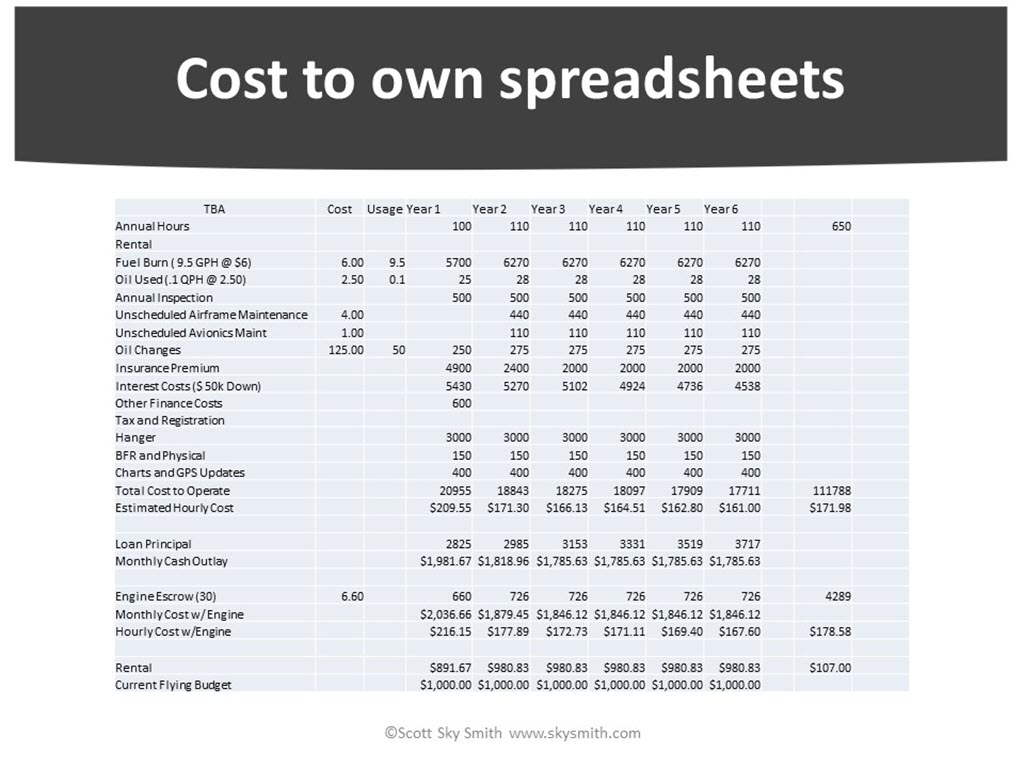
In previous articles (our July 2018 issue, among others), I talked about the cost to own compared to rent. A light twin is one of those that hit the rent/buy crossover mark at fairly low hours (somewhere between 20 and 30 hours a year). And the main reason is that the cost to rent a twin is usually very high, along with the pilot requirements. In fact, it is difficult to rent a twin-engine aircraft period, which is why most people need to buy their own.
Twins and Insurance
Twins are hard to get insured for low-time or transition pilots. In today’s market, many aviation insurance underwriters have stopped offering quotes on old multi-engine aircraft (and, as I have mentioned before, old pilots).
Old, regarding the age of the aircraft, is anything over 30 years for many companies. The problem is that most of the reasonably priced old twins are from the ’60s and ’70s, making them 50 to 60 years old. That’s way past the 30-year-old mark. Sure, there are newer twins, but we are talking about the “cheaper than a single” twins, which would probably be something like a Piper Aztec or (one of my favorites) Cessna 310.
Since it seems like a lot of the claims come from gear-related issues, like gear-up landings or gear failures, don’t buy hull coverage. That means buy liability-only coverage. Yes, you are at risk for the aircraft value, but it might be the only way to get a quote.
I’m not trying to drive you away from a twin-engine aircraft, it’s just important to quote the insurance (if you need it) first.
A few things to consider before you transition to a twin.
- Cost to operate. Remember, the purchase price is the least of your expenses. Maintaining the twin is the most important. Figure at least four times the fuel burn for most twins.
- Use of the aircraft. Do you really need a twin? Spend a lot of time at night, over trees, over water, over mountains, and you might need a twin.
- Pilot ratings. First, most companies will require an instrument rating to quote a twin. Second, if you don’t have a multi-engine rating, it’s probably better to get that in a cram course, if possible. It won’t really change the premiums, but if you already have the multi rating, it makes it a bit easier.
- Aircraft value. The value of the aircraft will also make a difference. Transition pilots in million-dollar planes are difficult to get coverage for. Start smaller and work your way up.
- Training. If you are not willing to fly lots of hours per year and do proficiency training, including emergency single-engine work on a regular basis, in my opinion, you should not buy a twin-engine aircraft. Even if the underwriter requires it, it’s usually only once a year, and I don’t think that’s enough. And if you don’t buy insurance and you don’t train, it’s probably not a good combination either.