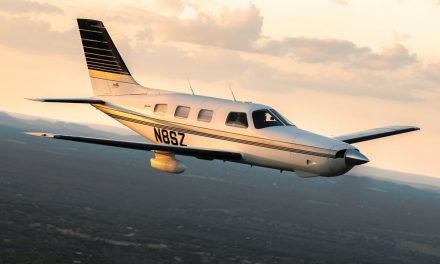
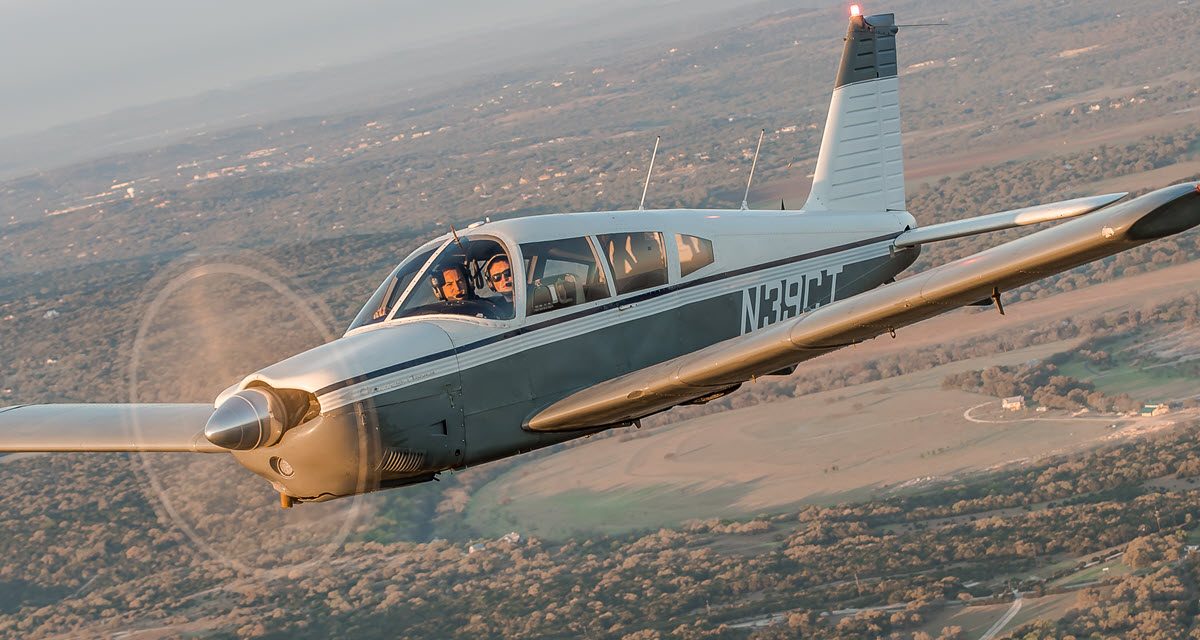
Photos by Jack Fleetwood (www.JackFleetwood.com)
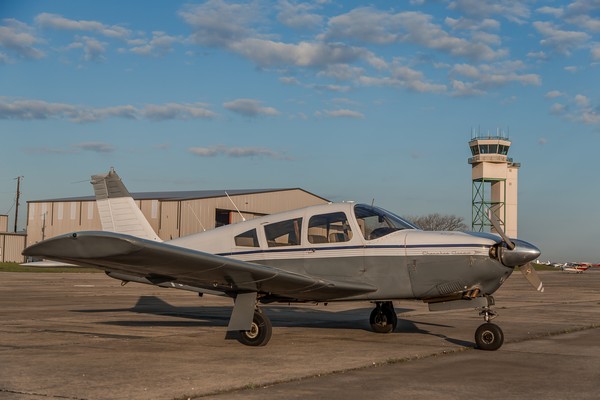
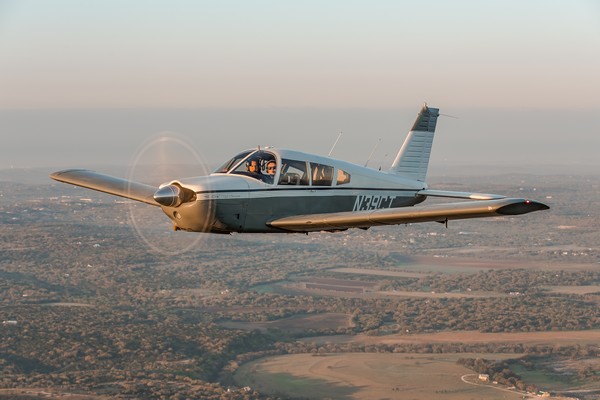
When the Piper Arrow premiered in 1967, it was little more than a retractable Cherokee 180 with a constant speed prop. The PA-28-180 had earned a reputation as one of the most capable, entry-level, four-seaters in the industry, and Piper hoped to parlay that status into a successful retractable.
They succeeded beyond their wildest dreams. Today, an amazing half-century later, the Arrow continues in a similar form to that original airplane. It features more horsepower, the inevitable improvement in paint, panel and interiors, plus a semi-tapered wing, but the basic configuration is very similar to the original PA-28-180R.
In fact, the current Arrow is the oldest surviving piston, production, single-engine retractable on the market, if only by one year. The Arrow is almost universally regarded as one of the best and least expensive airplanes for introducing students to complex aircraft.
Origins & Competitors
The Arrow took on a group of formidable targets in those early days, primarily the Mooney Ranger, Chaparral, and Executive – all variations on Al Mooney’s original four-seat single. There were also a number of medium-power entrants from several other manufacturers, many introduced specifically in answer to the Arrow’s success. During the same time frame, Commander fielded the wide-cabin, cruciform tail 112, 112TC and 114, Beech offered the Sierra (essentially a retractable Musketeer) and Cessna swept up the wheels on the Cardinal to produce the Cardinal RG.
The Arrow was, in some respects, a me-too design, intended to translate the Cherokee 180’s success to a retractable airplane with minimum variations from the original fixed-gear machine. The new Piper might not have been nearly as successful had it not been for the airplane’s unique, automatic gear extension system. A cure for the common accident.
Piper’s market research on the retractable market revealed that the most likely accident for retractable-gear airplanes was a gear-up landing, regarded as practically inevitable, even for experienced pilots. Though many of those accidents didn’t result in injuries or deaths, the standard catch phrase in those days was, “There are those who have (landed gear up), and those who are going to.” No, I haven’t – yet – but there’s still time.
Accordingly, Piper asked its engineers to investigate the possibility of a nearly foolproof automatic gear extension system, a mechanism that would shortstop a forgetful pilot and extend the wheels automatically if the operator failed to do so. The system Piper’s design team conjured up was relatively simple. It worked through a pneumatic sensing vane mounted directly below the pilot’s side window. This measured air pressure, similar to a pitot tube, and extended the wheels if ram air dropped below the equivalent of about 85-90 mph.

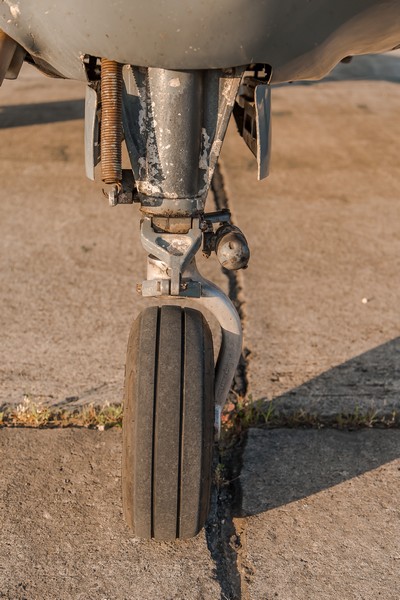
Since it was practically impossible to land an Arrow at that speed, this virtually guaranteed that there was no way to put the airplane on the ground without the gear fully extended. If the pilot forgot to lower the wheels, the red indicator would remain on as the system activated until all three green lights were on. After that, the pilot would have to stare at three greens and a red until he placed the gear lever in the down position.
Not exactly foolproof
But of course, as with any innovative, “fail-safe” improvement, there were a few glitches, none of them related to mechanical problems; all related to stupid pilot tricks. The pilot had the option of locking out the automatic system if he wished to practice departure stalls or other maneuvers that demanded gear up. This inevitably led to instances of a pilot activating the lock-out feature; then, forgetting that he’d disabled the auto extension system and proceeding to land gear up, despite flashing lights and blaring warning signals.
Another problem was that the pneumatic extension system wouldn’t allow the wheels to retract below about 90 mph – the prohibition airspeed varied from 85 to 95 mph, depending upon the individual airplane. This could make climb outs at Vx – best angle of climb speed – difficult.
The Arrow was nevertheless an instant success in a market that was to become crowded with 180-200 hp retractables. Almost immediately, the Arrow began to break Mooney’s virtual stranglehold on the class and gradually took over the sales race. This was despite Mooney’s significant advantage in all aspects of performance, not a big surprise since Mooneys are famous for extracting maximum performance from minimum horsepower.
In fact, the Arrow was so successful in draining away sales, it was probably one of several contributing factors that caused Mooney to file for bankruptcy in 1969. The type was to plod along under a succession of owners for another eight years until a major comeback was precipitated by the introduction of Roy Lopresti’s remarkably efficient Mooney 201 in 1977.
Insurance companies were delighted with the automatic gear extension feature, and for a time, a pilot with few flight hours in retractable-gear airplanes could be insured in an Arrow when he couldn’t be covered in any other folding-foot airplane.
The Arrow’s automatic gear down system seemed such a natural development that it was copied by two other manufacturers, specifically Bellanca Aircraft on the Viking 300 and Beechcraft on the Bonanza family of singles.
Apparently, no good deed goes unpunished, however. The Arrow’s gear-down assist system proved too good to be true. Several years after the airplane’s introduction, an Arrow lost power within easy gliding distance of an airport. The pilot allowed the Piper to get a little slow during the resulting dead stick descent, and the gear obediently plunked down with no power to get the wheels back up.
The Arrow’s severely-compromised glide caused it to crash short of the runway. The FAA investigated, determined that the auto-gear system was a contributing factor, and issued an airworthiness directive. As a result, Piper lost the resulting law suit, and deleted the automatic gear extension system on all subsequent Arrows. So much for the benefits of innovation and technology.
Simplicity sells
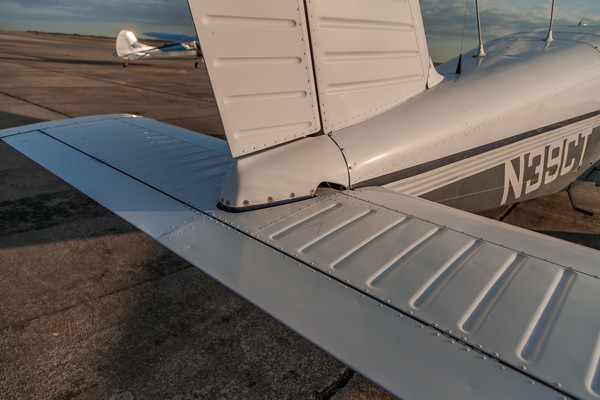
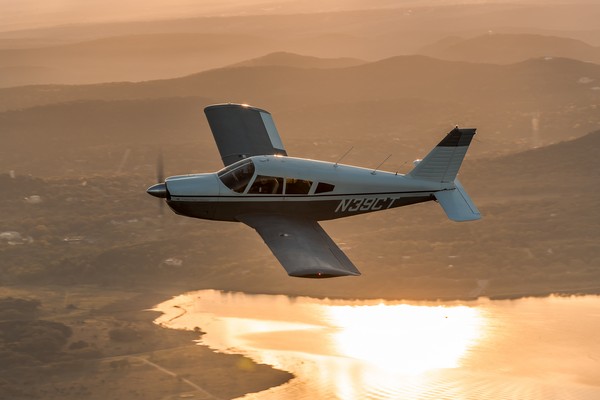
The Arrow still had much to offer. It flew with the same benign flight characteristics as the derivative Cherokee 180, a gentle, predictable stall and easy landing characteristics. By reason of the extra horsepower and lower drag signature, the Arrow offered slightly better cruise and climb than the fixed-gear Cherokee 180. The original wing was Piper’s Hershey-bar design, though that was soon upgraded to the semi-tapered Warrior airfoil, alleged to impart a slightly quicker roll rate. Not much has changed in that area, nor need it. For those interested in the wing’s technical details, it’s an NACA 64(2)-415 on the inboard panels, tapering to a TN2228 on the outboard section with 7 degrees of dihedral. Aren’t you glad you asked?
Pricing for success
The Arrow was generally sold at prices slightly lower than most, but not all, of the retractable competition. Indeed, the original 1967 airplane was priced at a typically-equipped $22,775 (compared to $20,987 for a manual-retraction system Mooney Ranger). The Arrow’s price of admission was also about $6,000 more than that of the fixed-gear Cherokee 180, perhaps not that surprising in view of the Arrow’s added complexity. Today’s Arrow has been updated in practically every area. Mooney and all the other 200 hp retractables are long-since out of production, and the 300 hp, six-seat G36 Bonanza is priced in a much higher class.
Weight and comfort considerations
If you don’t opt for such options as air conditioning or other weight consuming goodies, you should expect a full fuel payload of about 500 pounds, and that includes a full IFR stack of Garmin radios. That’s not bad when you consider the normal training payload at major institutional flight schools is usually three pilots – two students and an instructor. Small families might also find that acceptable – Mom, Dad and two kids.
The Arrow’s cabin is 42 inches wide by 45 inches tall, about the same dimensions as a Beech G36 Bonanza, so everyone should ride comfortably. Piper has developed the Arrow’s ventilation system to one of the best in the class, so even without air conditioning, it’s not a bad place to spend a few hours.
Performance isn’t the Arrow’s strongest suit. Even at sea level a fully loaded airplane scores less then 700 fpm climb, though Piper lists service ceiling at more than 16,000 feet. The Arrow probably wouldn’t work well at typical Rocky Mountain, mile-high density altitudes in summer, but for most East Coast and Midwest airports, it would be reasonably efficient.
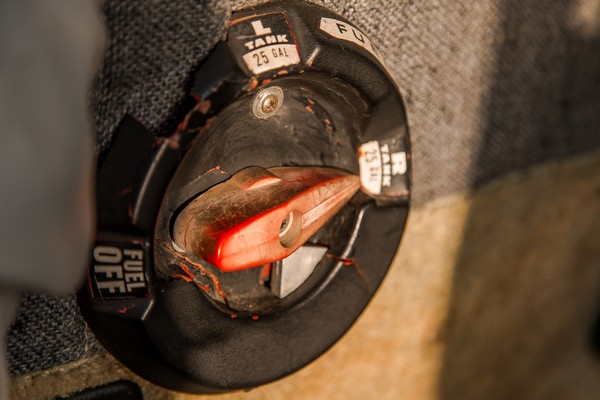
Cruise speed is nothing to write home about, something between 135-140 knots, but speed isn’t terribly relevant in an airplane that’s liable to be utilized primarily as a trainer. The Arrow does come equipped with 72-gallon tanks, however, and at a fuel burn of about 10.5 gph, you can plan on lingering aloft for perhaps 5.5 hours plus reserve. In no-wind conditions, that translates to about 825 nm between fuel stops. If you’re willing to throttle back and use 55 percent power, you might stretch that as far as 900 nm. That would allow you to manage one-stop transits from coast to coast in the lower USA.
Planning for landing
Runway requirements are short enough to allow access to most 1,500-foot long, unobstructed airports that sane folks would want to visit, and even adding the ubiquitous 50-foot obstacle would still allow takeoff and landing in less than 2,000 feet.
Of course, the Arrow’s primary claim to fame is that it’s an amazingly easy airplane to fly. Full flap stall speed is only 45 knots, so you needn’t feel out of your depth flying approaches at 60 knots. The flare is so easily predictable and the payoff so incredibly gentle that practically anyone can feel confident after only a few hours in an Arrow. Just remember, the gear no longer extends automatically.