By James Hofer, Aerohoff Inspection Services, FAA Repair Station
If you own a Piper PA-28 or PA-32, the wing spar eddy current inspection is an important required inspection that directly affects the structural integrity of your airplane. The purpose of this inspection is to detect fatique-related cracking in critical bolt holes of the lower wing spar before the damage becomes severe enough to compromise safety.
Several Piper service bulletins govern this inspection depending on the aircraft’s model and serial number. Service Bulletin 1345 was the original document issued for certain PA-28 and PA-32 aircraft and was later superseded by Service Bulletin 1372A. More recently, additional aircraft were added under Service Bulletin 1412. While the service bulletin that applies to your aircraft may differ, the eddy current inspection procedure itself has remained unchanged.
The inspection was made mandatory by FAA Airworthiness Directive 2020-26-16. Compliance is based on a calculated number of “factored hours,” which is determined by the number of 100-hour inspections the aircraft has accumulated over its lifetime rather than simply total airframe time.
The inspection focuses on four specific bolt holes located in the lower wing spar. These holes are critical load-carrying points in the wing structure. A high-frequency open-hole eddy current inspection is performed with the fasteners removed. This method allows the technician to detect very small cracks and corrosion pitting that cannot be seen visually. Proper calibration of the eddy current equipment is critical and must be done using an EDM notch placed in an open hole on the reference standard, as required by the service bulletin. Calibration using a surface notch does not meet the requirements and can lead to inaccurate results.
Based on inspections performed in the field, crack findings are relatively uncommon but not rare. AeroHoff Inspection Services has performed approximately 500 wing spar eddy current inspections, with 19 aircraft found to have crack-like indications, representing about four percent of the aircraft inspected. Most cracks were detected in the right forward bolt hole of the lower wing spar, typically propagating aft from the hole. Less frequently, cracks have been found in the left forward hole, and in rare cases, cracks have been present in both left and right forward holes.
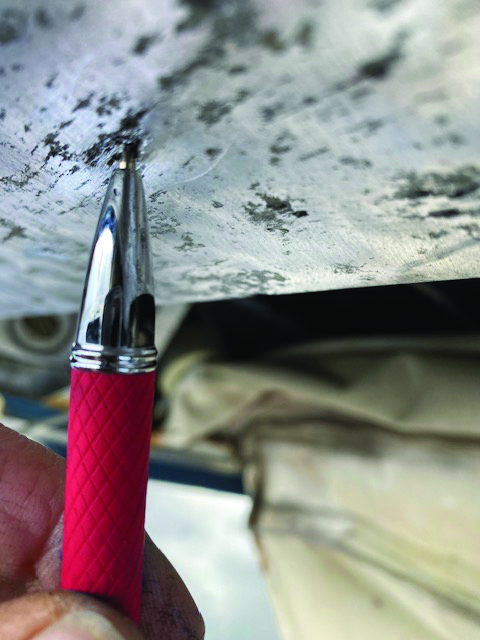
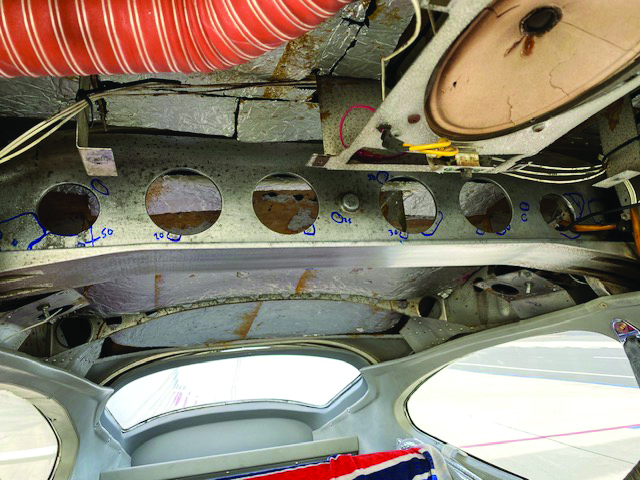
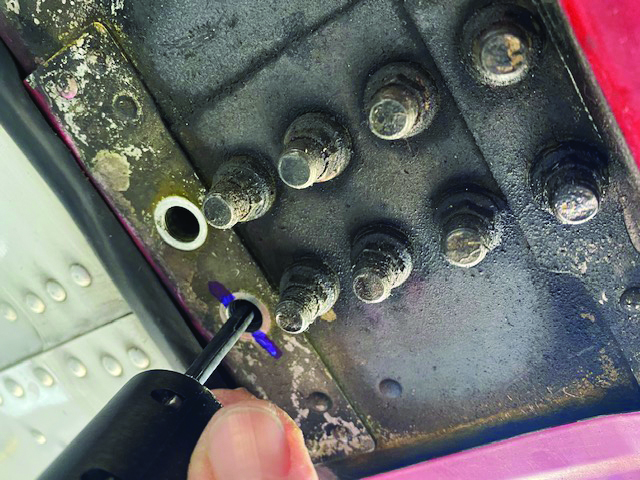
When an aircraft is rejected during the initial inspection, additional steps are often taken to confirm the finding. In many cases, the wing is removed and the area is reinspected using eddy current to verify the indication. A localized fluorescent penetrant inspection is then performed, which often makes the crack visible as penetrant seeps out of the defect. Crack sizes vary widely, ranging from very small defects measuring approximately 0.010 inches in length and depth, to much larger cracks that extend from the bolt hole to the edge of the spar and continue around nearly 180 degrees of the hole circumference. Regardless of size, once a crack exists, it will continue to grow if left unrepaired.
Because this inspection is performed inside bolt holes, technician experience plays a major role in the accuracy of the results. If the open-hole eddy current inspection is not evaluated correctly, a true crack can be missed or a good hole can be incorrectly rejected due to non-relevant conditions such as scratches, burrs, or minor gaps. Proper training, correct calibration, and experience interpreting signals are essential to producing reliable inspection results.
If an aircraft passes the eddy current inspection of all four required bolt holes, new fastener hardware must be installed before the aircraft is returned to service. If an aircraft fails the inspection, the only approved corrective action is replacement of the wing spar. There are no approved repairs for cracks in this area of the spar.
Owner Takeaway
This inspection is designed to find hidden structural cracks that cannot be seen during routine maintenance. Most Piper PA-28 and PA-32 aircraft pass the inspection without issue, but a small percentage do have cracks that would otherwise go undetected and continue to grow. Completing the inspection on time and ensuring it is performed by an experienced eddy current technician protects your safety, prevents unexpected downtime, and helps preserve the long-term value of your aircraft. If you are unsure which service bulletin applies to your airplane or when your inspection is due, it is best to address it early rather than wait until compliance becomes urgent.
Aerohoff Inspection Services is a mobile NDT lab, offering aviation NDT services worldwide. Located in California, we travel all over the world supporting our commercial airline, aviation, and aerospace clients. We have been performing NDT inspections for over 35 years and work with both metallic and composite structures.
Please contact us to schedule your next NonDestructive Testing (NDT) inspection.
Aerohoff Mobile NDT
FAA Repair Station I9OR058X
Oceanside, CA
760-567-4123
Sales@aerohoff.com
www.aerohoff.com
www.eddycurrentguys.net